
Course
The Science of Staying Rich
What actually causes wealth to stay in a family—and what causes it to disappear!
Most families get an estate plan… but never get a system.
And documents don’t stop wealth from leaking, families from fighting, or plans from failing under pressure.
Families go to lawyers and walk out with wills, trusts, and powers of attorney - a document set. And they think that they have a plan. Those documents are important—but they’re still just documents.
What most families aren’t given is the thing that actually keeps wealth in a family: a Wealth Protection System —
a practical framework for decisions, behavior, boundaries, and implementation that holds up when real life shows up. If you’ve built something worth protecting, you don’t need more paperwork. You need a system.
What you'll get:
In plain English, you’ll learn repeatable principles to:
- Stop wealth leaks before they become expensive mistakes
- Protect assets so one event doesn’t wipe out years of work
- Reduce surprise taxes and fees with smarter decision-making
- Create family rules that hold when emotions run high
- Turn “we should” into “it’s done” with checklists, templates, and action steps
Who is the For?
✅ For first-generation wealth builders who don’t want to start over
✅ For families preparing for inheritance who want unity—not conflict
✅ For anyone who wants fewer financial surprises and more control
Enrollment is limited for this release so we can give action-takers hands-on support and keep the community focused and engaged. If you’re seeing this page, spots are available right now—but they can close without notice.
No fluff. Action steps are included.
F. Keats Boyd III, Esq.
Meet Your Coach
Estate planning + wealth strategy, translated into plain English.
As an estate planning attorney and wealth protection strategist at Boyd & Boyd, PC, I’ve spent years helping families protect what they’ve built—through good seasons and hard ones. This course distills the patterns we see over and over: what works, what fails, and what families wish they’d done sooner.

Does this seem familiar?
You’re sitting at the kitchen table again.
Not because you love paperwork, but because that’s where real decisions get made. The kitchen table is where families turn into boards of directors without meaning to. It’s where you’ve mapped out vacations, talked about school, argued about budgets, and said things like, “We need to get serious about this.”
And there it is—an estate planning binder. Thick. Official. Heavy with good intentions. The kind of binder that makes you feel like you did the responsible thing just by owning it.
Inside are the documents everyone is told to get: a will, a trust, powers of attorney, health care documents. Signed, witnessed, notarized. All the boxes checked. The whole thing done the way grown-ups do it.
For a while, that binder gives you a quiet confidence. You’ve heard the horror stories. You decided your family wasn’t going to be one of them. You handled it.
Then time does what it always does.
Kids grow up. Careers shift. A new business starts. Someone buys property. Someone sells property. Someone marries. Someone remarries. Grandkids arrive. The family expands. The money changes shape. Some of it becomes less visible because it’s trapped inside assets, accounts, ownership interests, and “we’ll deal with that later” decisions.
And the binder stays on the shelf.
Not because it’s meaningless. Not because it was a mistake. It matters. But it doesn’t move with your family. It doesn’t sit with you when you’re tired. It doesn’t speak up when emotions are high. It doesn’t stop you before a “small” decision becomes an expensive one. It doesn’t protect wealth from the hazards that don’t announce themselves.
I’ve been an estate planning attorney for more than thirty-five years, and I’ve watched this story unfold in almost every variation you can imagine. I’ve helped families create plans to pass wealth, and I’ve also been called in when families were living through the consequences of what they thought would never happen. Maybe you've lived through that kind of experience.
The painful truth is that many families don’t lose wealth because they forgot to sign documents. They lose wealth because they never built the system behind the documents.
Families go to lawyers and walk out with wills, trusts, and powers of attorney. Those are important. I’ve spent my career helping people do that work correctly. But documents are not the same thing as a system. Lawyers sell documents. Your family needs a wealth protection system—something that actually holds when real life shows up.
Real life is rarely dramatic at first. It’s usually quiet. It starts with a decision that seems reasonable. A loan to a family member who “just needs a little help.” An asset titled the easy way instead of the safe way. A business deal made on trust and optimism instead of structure. A boundary that never gets set because nobody wants to feel “mean.” A plan that the kids don’t understand, so they never really respect it. A conversation that gets delayed until “later,” and later turns into never.
Most people also carry a quiet belief in the background: bad things won’t happen to me. Lawsuits happen to other people. Divorce happens to other people. Family conflict happens to other people. A health crisis happens to other people. A sudden tax problem happens to other people. A business partner turning into a liability happens to other people.
Optimism feels good. But optimism is not a strategy. Time doesn’t care how good your intentions were. And wealth, if it’s visible, becomes a target.
Divorce is one of the most efficient wealth hunters ever invented. It doesn’t send a warning letter. It doesn’t check your calendar. It doesn’t wait until you have everything cleaned up. It arrives, and suddenly wealth becomes something to divide, pursue, and reach for. People are shocked by how quickly a private family matter turns into a public process with incentives that don’t care about your long-term goals.
Lawsuits don’t ask permission either. A health event doesn’t coordinate with your plans. A business downturn doesn’t consult your timeline. And the moment you’re forced to make high-stakes decisions under pressure, the binder on the shelf is not enough. Because the binder never taught anyone how to make those decisions. It never trained the family. It never aligned them. It never installed rules of the road.
The most dangerous moment for family wealth isn’t the market. It’s the handoff.
A parent passes and, at first, everyone is kind. Everyone says the right things. Everyone means well. There’s grief, and there’s love, and there’s the shared sense that the family should stay united.
Then a sentence slips out. Not a screaming match. Not a villainous declaration. Just a sentence.
“Well, Dad always said…”
“Mom promised me…”
“I thought the plan was…”
“That doesn’t seem fair.”
And suddenly, childhood has a way of walking back into the room.
It’s amazing how quickly old roles reappear. The responsible one. The impulsive one. The one who stayed close. The one who moved away. The one who always needed help. The one who thinks nobody notices what they do. People are not evil; they’re human. And grief has a way of dragging old stories out of storage.
I have watched childhood sibling rivalries surface after a parent passes, not because the siblings set out to be cruel, but because the old emotional math is still there, waiting for a trigger. And inheritance has a way of becoming the trigger. It turns unspoken comparisons into spoken accusations. It turns assumptions into conflicts. It turns “we’ll figure it out” into “get a lawyer.”
This is also where I’ve seen the flaws in plans created elsewhere. I’ve seen trusts that looked impressive on paper but were never matched to how the family actually lived. I’ve seen structures that depended on children understanding the plan, but no one ever taught the children anything. I’ve seen plans that assumed harmony where harmony never existed. I’ve seen plans that treated family wealth as if it were a simple transfer instead of a living system that requires stewardship.
And the saddest part is that many of those failures were preventable. Not with more pages. With more wisdom.
There’s an old proverb people repeat like a joke: "Shirt sleeves to shirt sleeves in three generations." The first generation builds it. The second generation benefits from it. The third generation blows it.
People say it like it’s destiny. It isn’t destiny. It’s physics.
Wealth attracts emotion, temptation, entitlement, and conflict. It also attracts risk: taxes, lawsuits, poor decisions, and bad incentives. If a family doesn’t understand that wealth must be managed and scaled, it gets eaten by time. If a family doesn’t understand stewardship, wealth becomes a toy, and toys get broken.
Sometimes I think about the seagulls in Finding Nemo. They swoop in, wild-eyed, shouting, “Mine! Mine! Mine!” It’s funny in a movie. It’s tragic in a family. When wealth becomes mine-mine-mine, unity dies. And when unity dies, wealth is easy prey.
The families who stay wealthy don’t treat wealth like a personal trophy. They treat it like stewardship. They see themselves as caretakers of something meant to bless the next generation—not just consumers of something meant to fund today’s appetites.
After decades of watching outcomes, I started searching for the principles underneath staying rich, because the families who succeeded were doing something repeatable. They weren’t lucky. They had a method. They had an operating system.
And the more I studied, the more I realized the concept wasn’t new. The “science” of staying rich is old—written into the backbone of serious thinking for generations. John Locke’s ideas about property and responsibility. Thomas Jefferson’s understanding that freedom requires discipline and education or it decays. Adam Smith’s insights about incentives and human behavior, which explain family dynamics more than most families want to admit. Milton Friedman’s insistence on tradeoffs and consequences, because every financial decision is a tradeoff whether you label it that way or not. Neumann and Morgenstern’s work on strategic decision-making when incentives collide, which is exactly what happens when siblings have different goals and emotions are high. Even Wallace Wattles, in his own way, emphasized principles, focus, and disciplined action—because wealth that lasts is rarely the result of random bursts of effort; it’s the result of consistent decisions over time.
Different writers, different centuries, different styles—one common thread.
When I finally sat back to review it all, what struck me wasn’t some cold, cynical “win at all costs” worldview, like so many people believe is the view of the wealth creators. It was something much more practical—and much more hopeful. These writers show something the modern world forgets: a lot of life is not a pie with eight slices where your gain must be my loss. In the real world, value can be created. Cooperation can beat conflict. Clear rules can turn rivalry into alignment. Good structures can turn fear into confidence. That’s what a healthy family does when they treat wealth as stewardship rather than a scramble for scraps.
Because the most destructive belief I see—inside families and now in the broader culture—is the idea that accumulating wealth must come at someone else’s expense. That’s a zero-sum lens, and it produces zero-sum behavior: envy, resentment, guilt, and the subtle assumption that if you have more, you must have taken it. But families who stay wealthy understand a different truth: wealth is often built by serving people, solving problems, creating jobs, improving communities, and multiplying opportunity. It can be positive-sum—everybody can get better off when incentives are aligned and the system rewards contribution instead of conflict.
And here’s the practical takeaway: when a family adopts the zero-sum mindset, the handoff becomes a fight. Everything feels like “mine.” Every decision becomes political. Every conversation turns into a scorecard. But when a family adopts the positive-sum mindset, the handoff becomes a mission. People stop asking, “What do I get?” and start asking, “What are we building, and how do we keep it growing for the people who come after us?” That mindset doesn’t just feel better. It produces better outcomes—less conflict, more unity, better decisions, and a legacy that actually lasts.
If you want results that last, you need principles that last, turned into a system real people can follow.
That is why I created The Science of Staying Rich.
It is not another binder. It is not another lecture. It is not theory meant to impress you. It is a wealth protection system built for real families—the kind of families who have worked hard, made sacrifices, built businesses, invested wisely, and want what they’ve built to stay a blessing instead of becoming a burden.
It is meant to be understood by your family, not just filed away. It is meant to help you see wealth leaks before they drain you. It is meant to help you build protection before life tests you. It is meant to help your children understand the plan instead of ignoring it because it feels abstract. It is meant to help your family keep unity when emotions run hot and stakes are high.
And if, as you read this, you can see yourself at that kitchen table—responsible, hardworking, well-intentioned—staring at a binder and realizing, “We have documents, but we don’t yet have the system,” then you’re not behind.
You’re right on time.
Because the goal isn’t to get wealthy once.
The goal is to stay wealthy on purpose.
Based on the book
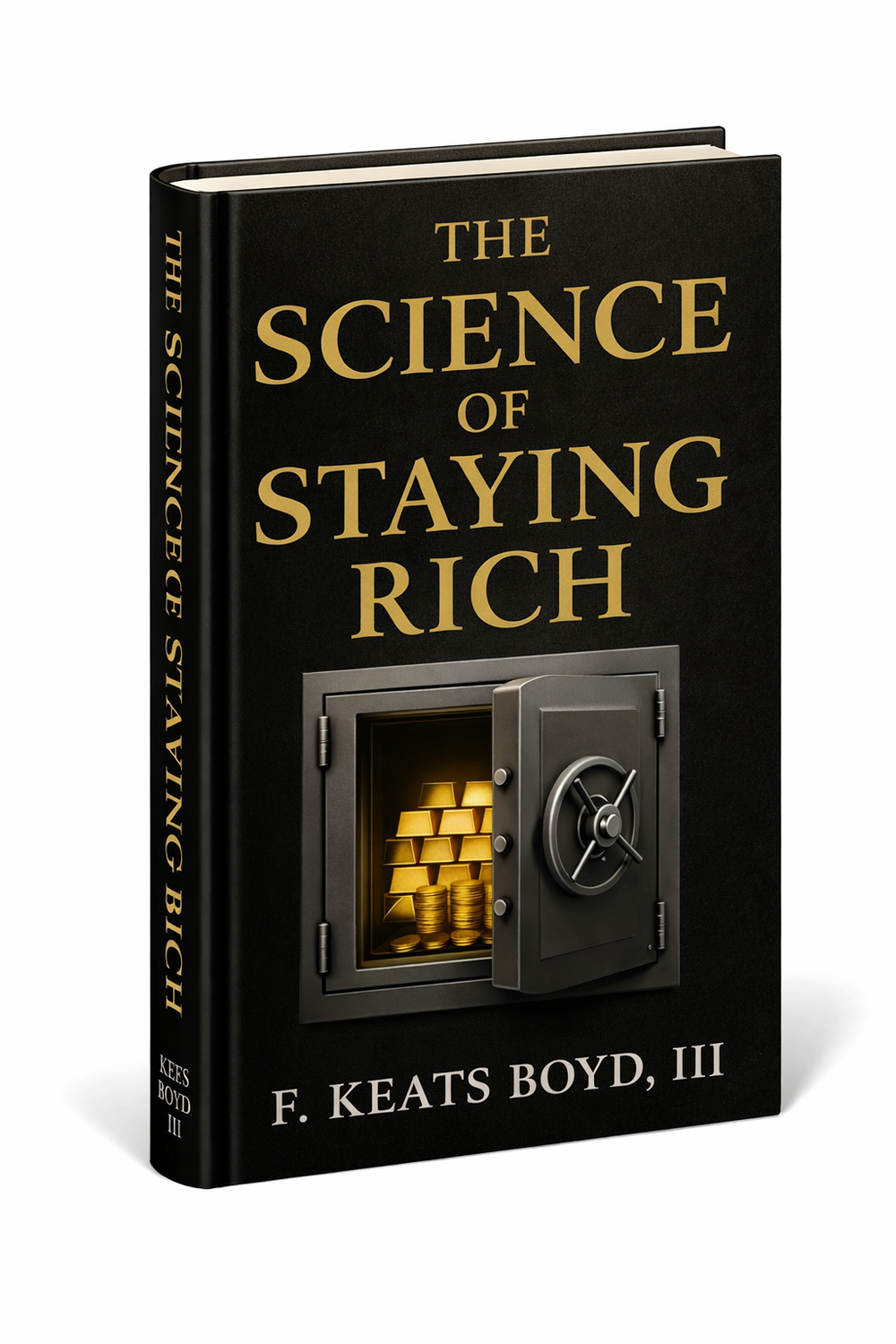
Soon to Be Available Wherever Books are Sold
Build Your “Wealth Fortress”
— The Private System That Keeps Your Family Rich, Peaceful, And Growing For Generations…
In 12 months, we install a living, repeatable rhythm (not a one-time event):
Vision → Gratitude → Order → Action → Increase
…so your wealth stays alive, circulating, and renewing through the generations.
Who This Is For
✅ You’ve built real wealth… but you know documents alone won’t preserve intent.
✅ You want your family to run on clarity instead of confusion.
✅ You want a system that produces peace, not bureaucracy.
What This Is
This is the architecture + governance + rhythm that makes wealth endure: structure, roles, meetings, review, documentation, education, and “how we decide.”
What This Is NOT
This is NOT a new set of documents. There are no trust amendments, no will codicils, no business organization filings. Sometimes document updates are needed. Our affiliated law firm can provide these services if desired.
HERE’S WHAT YOU GET:
The Core Program: “Wealth Fortress Private Buildout”
A fortress isn’t one wall—it’s layers. Our model is based on four pillars, interdependent, nearly unbreakable when installed together:
Asset Protection + Tax Efficiency + Succession Governance + Education & Empowerment
1) The “Certain Way OS” Blueprint (Your Family’s Wealth Operating System)
We codify the full formula into a simple playbook your family can actually live:
Vision (compass), Gratitude (heartbeat), Order (architecture), Action (circulation), Increase (breath of life)
2) The Wealth Fortress Framework (Installed + Documented)
We translate philosophy into form—“wealth organized,” built as a living system that is serviced, updated, and tested.
3) The Governance Framework (The Command Center)
Because without governance, you get a “castle without command.”
We install the governance triad:
• Advisory Board model (expertise serves the family; decisions stay deliberate)
• Family Council (the table where voices meet; gratitude becomes conversation)
• Family Constitution (values, membership, leadership, conflict resolution)
4) The Rhythm of Review System (The Heartbeat That Prevents Drift)
A clear, scheduled cadence that keeps wealth from calcifying:
• Monthly check-in
• Quarterly structured meeting
• Annual family summit (governance + gratitude + education)
“This rhythm is not about paperwork; it’s about presence.”
5) Education & Empowerment (Turn Beneficiaries Into Stewards)
Because the “most ignored” pillar is often the most essential: education is “oxygen.”
PRIVATE ACCESS
12-Month Private Buildout
• 12 private sessions (monthly) to build + install the system
• “Rhythm Support” between sessions (bounded, business-hours)
• Unity & Purpose Session (get the adults aligned on vision + tone + roles)
🎁 Bonus #1: “Recordkeeping as Ritual” Vault Templates
Minutes, memos, decision logs—so future stewards inherit biography, not bureaucracy.
🎁 Bonus #2: “Impression of Increase” Culture Kit
Increase isn’t just money—it’s the outward sign of inward harmony.
We install simple rituals that keep the family’s identity oriented toward growth.
🎁 Bonus #3: WealthChain Orientation Briefing (Concept → Continuity)
A practical briefing on “digital stewardship”: a registry that is timestamped, encrypted, immutable, built to prevent wealth being “lost to paperwork.”
Value: $15,000
Value: $25,000
Value: $20,000
Value: $12,000
Value: $10,000
Value: $18,000
Value: $5,000
Value: $5,000
Value: $7,500
WHAT YOU & YOUR FAMILY GET:
• Certain Way OS Blueprint — $15,000
• Wealth Fortress Framework —$25,000
• Governance Framework — $20,000
• Rhythm of Review System — $12,000
• Education & Empowerment Track — $10,000
• 12-Month Private Buildout — $18,000
• Recordkeeping Vault Templates — $5,000
• Impression of Increase Culture Kit — $5,000
• WealthChain Orientation Briefing — $7,500
Total Value: $117,500
YOUR INVESTMENT:
Normal Price: $50,000
Founding Member Discounted Price: $25,000
Founding Member Limit: 20 families (then it closes)!
Creating Wealth Is Hard.
Keeping Wealth in the Family Is Harder.
Most people think the hard part is making money.
But families lose wealth because they lack systems—not intelligence.
In this course, you’ll build the foundations first, then progress into advanced strategies step by step, with real-world practice—so you’re not just “learning,” you’re implementing.
Cashflow Control
Asset Protection
Tax Efficiency
Family Governance
Legacy Transfer
Monthly LIVE
Coaching Calls

Monthly live coaching keeps you moving—because knowledge without execution doesn’t protect anything.
You’ll get:
- Accountability to implement the right next step (not 20 steps at once).
- Clarity when life changes (new businesses, new state, new baby, new property, new risk)
- Practical feedback so you avoid expensive trial-and-error
The Course That Turns
“I Should” Into “It’s Done.”
Most financial education stops at motivation or theory. This is different.
You’ll leave with a working framework for keeping what you build—and passing it on intentionally.
Feature #1
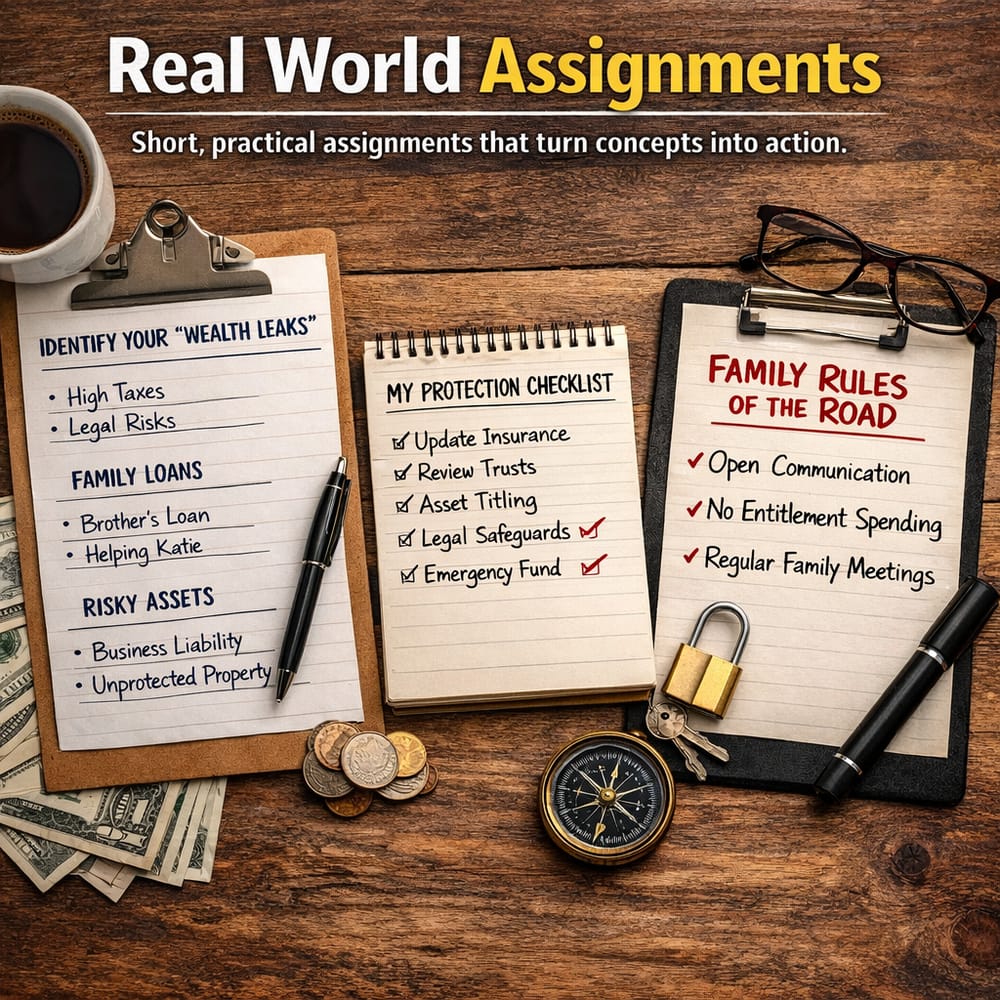
Real World Assignments
Lorem ipsum dolor sit amet, consectetur adipisicing elit. Autem dolore, alias, numquam enim ab voluptate id quam harum ducimus cupiditate similique quisquam et deserunt, recusandae.
Real World Assignments
Short, practical assignments that turn concepts into action—like documenting your “wealth leaks,” building your protection checklist, and designing your family’s rules of the road.
Expert Guidance (Without the Overwhelm)
Get the “why” and the “what now.” We’ll translate complex wealth topics into simple decisions you can actually make—confidently.
Feature #2
Expert Guidance

Lorem ipsum dolor sit amet, consectetur adipisicing elit. Autem dolore, alias, numquam enim ab voluptate id quam harum ducimus cupiditate similique quisquam et deserunt, recusandae.
Feature #3
Lifetime Updates

Lorem ipsum dolor sit amet, consectetur adipisicing elit. Autem dolore, alias, numquam enim ab voluptate id quam harum ducimus cupiditate similique quisquam et deserunt, recusandae.
Ongoing Support Option
At the end of the program, we can discuss continuing support to keep your plan current as rules and best practices change.

Join The Community
You’ll be surrounded by people who care about building wealth the right way—and keeping it with wisdom and discipline. Ask questions, share wins, and get unstuck quickly.
"
Keats does a terrific job explaining and summarizing the detailed estate planning concepts the Trusts contain to protect and pass on our assets for our children and hopefully our grandchildren.
Geralyn

"
We attended a Seminar led by Keats. It was informative and made us rethink our current estate plan. His creative thinking led us to believe our plan lacked protective mechanisms that were not originally considered. The process was seamless and quite enjoyable. Great people with thoughtful planning techniques! Highly recommend!
Howard

"
Don't think twice, this course is pure gold. I have been a part of this community for 2 years now and still learning every day and getting better and better.
James
"
This is by far the best course on photography. Almost all my shots are going viral on TikTok and Instagram.
Emily
Questions?
FAQs
Frequently Asked Questions about The Science of Staying Rich Programs
#1 Is this legal or tax advice?
No. This course is educational. If you want legal advice specific to your situation, The Law Offices of Boyd & Boyd, P.C. will be happy to assist you.
#2 Who is this for?
Anyone who wants to keep wealth: business owners, professionals, retirees, and families preparing for inheritance.
#3 How long do I have access?
As long as your subscription is active, you’ll have ongoing access (and updates), so you can revisit modules as your life changes.
#4 Do you offer Guarantee?
YES!! We have a 30-Day Action-Taker Guarantee:
Complete Module 1 and the included assignments within your first 30 days. If you don’t feel the course delivered real value, email us within 30 days and we’ll refund your purchase.
The Science of Staying Rich
